 Add to Chrome
 Add to Firefox
 Add to Edge
Skill is Not One-Size-Fits-All: Model-Aware Skill Alignment for LLM Agents
May 29, 2026
LLM agents increasingly retrieve externally curated skills-procedural instructions retrieved at decision time-to improve performance on long-horizon interactive tasks. Existing skill libraries are typically treated as model-agnostic, reusing the same skill formulations across backbones with substantially different capacities and behaviors. However, our controlled experiments across multiple model scales show that skill effectiveness is strongly model-dependent: a skill that benefits one backbone can harm another. Motivated by this observation, we propose MASA Model-Aware Skill Alignment, a framework that adapts skills to each target backbone without modifying agent weights. MASA operates in two stages: (1) a hierarchical skill evolution pipeline that iteratively rewrites general and task-specific skills using hill climbing and UCB-driven tree search, guided by environment feedback and model capability profiles; and (2) a lightweight model-conditioned skill rewriter trained on evolution trajectories to reproduce the adaptation in a single forward pass. Experiments across three interactive environments and four backbones show that MASA consistently achieves the best overall performance, with gains of up to 25.8 points over the strongest baseline. The learned rewriter further generalizes to unseen tasks and environments without additional search, consistently outperforming a much larger teacher LLM at a fraction of the inference cost.

Retrieval, Reward, and Training Protocols: What Matters in Training Search Agents?
May 27, 2026Search agents powered by large language models can autonomously decompose queries, retrieve information, and synthesize answers through multi-step reasoning. However, the rapid growth of training methods has outpaced controlled comparison: existing works differ in retrieval corpora, reward designs, and training protocols, making it unclear what actually drives improvements. We present a controlled empirical study that isolates three under-explored dimensions of search agent training. First, we identify a critical data-coverage issue in the widely used Wikipedia 2018 corpus and show that correcting it alone yields larger gains than the differences between training algorithms. Second, we systematically compare outcome-based and process-based reward methods across three base models, finding that the simplest outcome-based approach achieves competitive or superior performance in most settings, and that process-level credit assignment can over-correct agent behavior. Third, we analyze training data diversity, off-policy data utilization, and search budget scaling, distilling practical guidelines for training effective search agents. Our code is available at https://github.com/YiboZhao624/SearchAgentReview.
OpenMobile: Building Open Mobile Agents with Task and Trajectory Synthesis
Apr 16, 2026Mobile agents powered by vision-language models have demonstrated impressive capabilities in automating mobile tasks, with recent leading models achieving a marked performance leap, e.g., nearly 70% success on AndroidWorld. However, these systems keep their training data closed and remain opaque about their task and trajectory synthesis recipes. We present OpenMobile, an open-source framework that synthesizes high-quality task instructions and agent trajectories, with two key components: (1) The first is a scalable task synthesis pipeline that constructs a global environment memory from exploration, then leverages it to generate diverse and grounded instructions. and (2) a policy-switching strategy for trajectory rollout. By alternating between learner and expert models, it captures essential error-recovery data often missing in standard imitation learning. Agents trained on our data achieve competitive results across three dynamic mobile agent benchmarks: notably, our fine-tuned Qwen2.5-VL and Qwen3-VL reach 51.7% and 64.7% on AndroidWorld, far surpassing existing open-data approaches. Furthermore, we conduct transparent analyses on the overlap between our synthetic instructions and benchmark test sets, and verify that performance gains stem from broad functionality coverage rather than benchmark overfitting. We release data and code at https://njucckevin.github.io/openmobile/ to bridge the data gap and facilitate broader mobile agent research.
Intern-S1-Pro: Scientific Multimodal Foundation Model at Trillion Scale
Mar 26, 2026We introduce Intern-S1-Pro, the first one-trillion-parameter scientific multimodal foundation model. Scaling to this unprecedented size, the model delivers a comprehensive enhancement across both general and scientific domains. Beyond stronger reasoning and image-text understanding capabilities, its intelligence is augmented with advanced agent capabilities. Simultaneously, its scientific expertise has been vastly expanded to master over 100 specialized tasks across critical science fields, including chemistry, materials, life sciences, and earth sciences. Achieving this massive scale is made possible by the robust infrastructure support of XTuner and LMDeploy, which facilitates highly efficient Reinforcement Learning (RL) training at the 1-trillion parameter level while ensuring strict precision consistency between training and inference. By seamlessly integrating these advancements, Intern-S1-Pro further fortifies the fusion of general and specialized intelligence, working as a Specializable Generalist, demonstrating its position in the top tier of open-source models for general capabilities, while outperforming proprietary models in the depth of specialized scientific tasks.
OS-Themis: A Scalable Critic Framework for Generalist GUI Rewards
Mar 19, 2026Reinforcement Learning (RL) has the potential to improve the robustness of GUI agents in stochastic environments, yet training is highly sensitive to the quality of the reward function. Existing reward approaches struggle to achieve both scalability and performance. To address this, we propose OS-Themis, a scalable and accurate multi-agent critic framework. Unlike a single judge, OS-Themis decomposes trajectories into verifiable milestones to isolate critical evidence for decision making and employs a review mechanism to strictly audit the evidence chain before making the final verdict. To facilitate evaluation, we further introduce OmniGUIRewardBench (OGRBench), a holistic cross-platform benchmark for GUI outcome rewards, where all evaluated models achieve their best performance under OS-Themis. Extensive experiments on AndroidWorld show that OS-Themis yields a 10.3% improvement when used to support online RL training, and a 6.9% gain when used for trajectory validation and filtering in the self-training loop, highlighting its potential to drive agent evolution.
OdysseyArena: Benchmarking Large Language Models For Long-Horizon, Active and Inductive Interactions
Feb 05, 2026The rapid advancement of Large Language Models (LLMs) has catalyzed the development of autonomous agents capable of navigating complex environments. However, existing evaluations primarily adopt a deductive paradigm, where agents execute tasks based on explicitly provided rules and static goals, often within limited planning horizons. Crucially, this neglects the inductive necessity for agents to discover latent transition laws from experience autonomously, which is the cornerstone for enabling agentic foresight and sustaining strategic coherence. To bridge this gap, we introduce OdysseyArena, which re-centers agent evaluation on long-horizon, active, and inductive interactions. We formalize and instantiate four primitives, translating abstract transition dynamics into concrete interactive environments. Building upon this, we establish OdysseyArena-Lite for standardized benchmarking, providing a set of 120 tasks to measure an agent's inductive efficiency and long-horizon discovery. Pushing further, we introduce OdysseyArena-Challenge to stress-test agent stability across extreme interaction horizons (e.g., > 200 steps). Extensive experiments on 15+ leading LLMs reveal that even frontier models exhibit a deficiency in inductive scenarios, identifying a critical bottleneck in the pursuit of autonomous discovery in complex environments. Our code and data are available at https://github.com/xufangzhi/Odyssey-Arena
TIDE: Trajectory-based Diagnostic Evaluation of Test-Time Improvement in LLM Agents
Feb 03, 2026Recent advances in autonomous LLM agents demonstrate their ability to improve performance through iterative interaction with the environment. We define this paradigm as Test-Time Improvement (TTI). However, the mechanisms under how and why TTI succeed or fail remain poorly understood, and existing evaluation metrics fail to capture their task optimization efficiency, behavior adaptation after erroneous actions, and the specific utility of working memory for task completion. To address these gaps, we propose Test-time Improvement Diagnostic Evaluation (TIDE), an agent-agnostic and environment-agnostic framework that decomposes TTI into three comprehensive and interconnected dimensions. The framework measures (1) the overall temporal dynamics of task completion and (2) identifies whether performance is primarily constrained by recursive looping behaviors or (3) by burdensome accumulated memory. Through extensive experiments across diverse agents and environments, TIDE highlights that improving agent performance requires more than scaling internal reasoning, calling for explicitly optimizing the interaction dynamics between the agent and the environment.
OS-Symphony: A Holistic Framework for Robust and Generalist Computer-Using Agent
Jan 12, 2026While Vision-Language Models (VLMs) have significantly advanced Computer-Using Agents (CUAs), current frameworks struggle with robustness in long-horizon workflows and generalization in novel domains. These limitations stem from a lack of granular control over historical visual context curation and the absence of visual-aware tutorial retrieval. To bridge these gaps, we introduce OS-Symphony, a holistic framework that comprises an Orchestrator coordinating two key innovations for robust automation: (1) a Reflection-Memory Agent that utilizes milestone-driven long-term memory to enable trajectory-level self-correction, effectively mitigating visual context loss in long-horizon tasks; (2) Versatile Tool Agents featuring a Multimodal Searcher that adopts a SeeAct paradigm to navigate a browser-based sandbox to synthesize live, visually aligned tutorials, thereby resolving fidelity issues in unseen scenarios. Experimental results demonstrate that OS-Symphony delivers substantial performance gains across varying model scales, establishing new state-of-the-art results on three online benchmarks, notably achieving 65.84% on OSWorld.
GRACE: Reinforcement Learning for Grounded Response and Abstention under Contextual Evidence
Jan 08, 2026Retrieval-Augmented Generation (RAG) integrates external knowledge to enhance Large Language Models (LLMs), yet systems remain susceptible to two critical flaws: providing correct answers without explicit grounded evidence and producing fabricated responses when the retrieved context is insufficient. While prior research has addressed these issues independently, a unified framework that integrates evidence-based grounding and reliable abstention is currently lacking. In this paper, we propose GRACE, a reinforcement-learning framework that simultaneously mitigates both types of flaws. GRACE employs a data construction method that utilizes heterogeneous retrievers to generate diverse training samples without manual annotation. A multi-stage gated reward function is then employed to train the model to assess evidence sufficiency, extract key supporting evidence, and provide answers or explicitly abstain. Experimental results on two benchmarks demonstrate that GRACE achieves state-of-the-art overall accuracy and strikes a favorable balance between accurate response and rejection, while requiring only 10% of the annotation costs of prior methods. Our code is available at https://github.com/YiboZhao624/Grace..
OS-Oracle: A Comprehensive Framework for Cross-Platform GUI Critic Models
Dec 18, 2025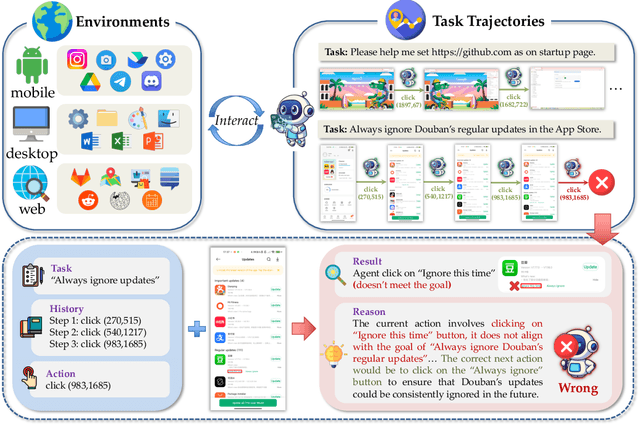
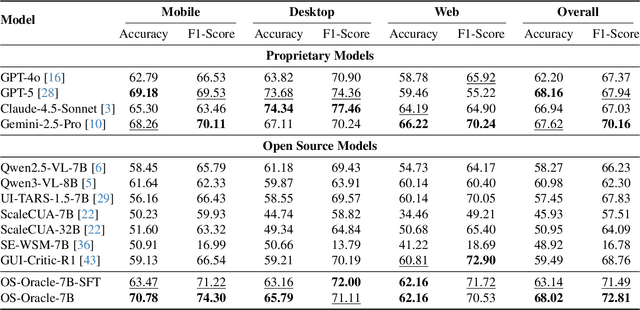
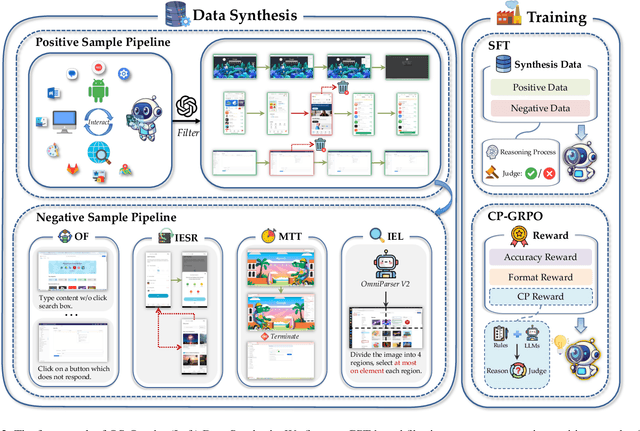
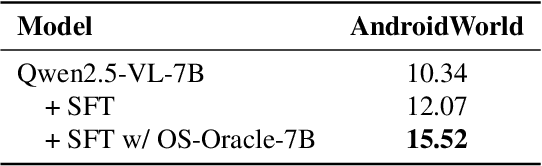
With VLM-powered computer-using agents (CUAs) becoming increasingly capable at graphical user interface (GUI) navigation and manipulation, reliable step-level decision-making has emerged as a key bottleneck for real-world deployment. In long-horizon workflows, errors accumulate quickly and irreversible actions can cause unintended consequences, motivating critic models that assess each action before execution. While critic models offer a promising solution, their effectiveness is hindered by the lack of diverse, high-quality GUI feedback data and public critic benchmarks for step-level evaluation in computer use. To bridge these gaps, we introduce OS-Oracle that makes three core contributions: (1) a scalable data pipeline for synthesizing cross-platform GUI critic data; (2) a two-stage training paradigm combining supervised fine-tuning (SFT) and consistency-preserving group relative policy optimization (CP-GRPO); (3) OS-Critic Bench, a holistic benchmark for evaluating critic model performance across Mobile, Web, and Desktop platforms. Leveraging this framework, we curate a high-quality dataset containing 310k critic samples. The resulting critic model, OS-Oracle-7B, achieves state-of-the-art performance among open-source VLMs on OS-Critic Bench, and surpasses proprietary models on the mobile domain. Furthermore, when serving as a pre-critic, OS-Oracle-7B improves the performance of native GUI agents such as UI-TARS-1.5-7B in OSWorld and AndroidWorld environments. The code is open-sourced at https://github.com/numbmelon/OS-Oracle.